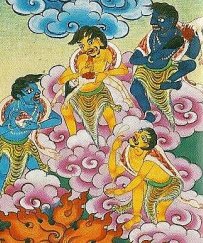
This is part of a series of posts about The Tibetan Book of The Dead. I'm reading the Penguin Classics Deluxe Edition, first published in Britain 2005, with introductory comments from the Dalai Lama. Includes amazingly stunning artwork.
Previous posts in this series include the assembly of peaceful and wrathful deities, and how eating dogshit can help you avert death
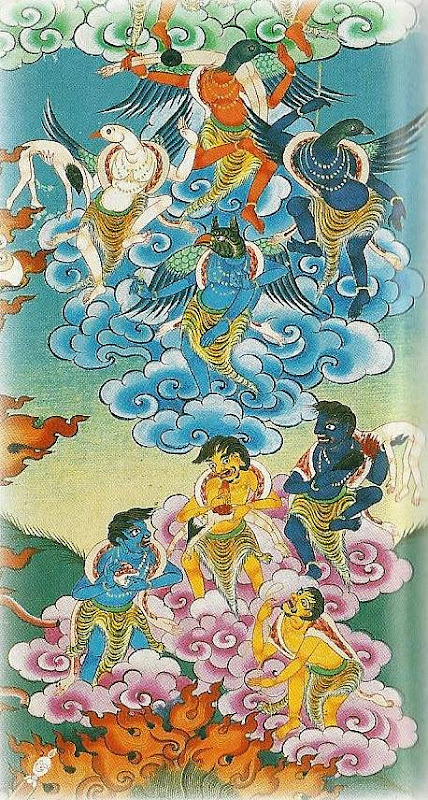
Much of the material is ludicrous (in my eyes at the time) and impenetrable (to me): seems to be "metaphysical mumbo-jumbo".
It's one of those books you really have to wrestle with, work at.
I'm going to dispense with "(to me)" and its cousins. Let's agree there is an invisible "in my humble opinion" (IMHO) at the start of each sentence (and they're long sentences, with hard labour, for Life!).
A lot of the Book is about folklore and ritual. But IMHO there are parts that offer deep insight into human psychology. Parts of the Book are highly thought-provoking. Some of it is a relatively pure, undistorted source of some aspects of "new age" thinking.
On page 47, for example, are a series of statements that some would say clarify and enhance the "living in the now" meme. Or, as the Book itself puts it, "Now follows the esoteric instruction which reveals the three times to be one..." (the three times being past, future and present) and closes the page with "Do not meditate at all, since there is nothing upon which to meditate.
Now, you gotta admit, that whatever your personal belief-system, and how thirsty that makes you, it's refreshing to encounter material that tells you NOT to meditate. And there's a delicious irony that so many bloody meditative words have been spilled based upon a misunderstood text that advises there is nothing to meditate upon.
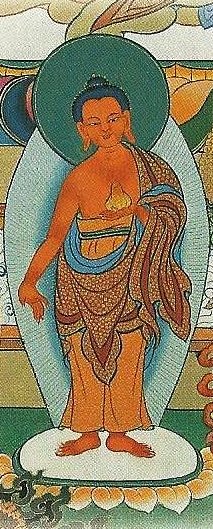 You stumble on a bunch of stuff that you try to put together in a sensible way. You fail miserably. But your very failure shows you that the bunch of stuff was once a coherent whole. Because among that stuff are bits and pieces that shouldn't be there, couldn't be there, don't seem to belong there. And the mere fact they ARE there suggests the broken and distorted shape of what once might have been there.
Put it another way. You have lots of money. You put together a think-tank of the best and brightest persons on the planet. The think-tank has a research team that includes the world's best archaeologists, historians, anthropologists, physicists, philosophers, mathematicians, psychologists, astronomers and more. There's also a communication team comprising the best scriptwriters, novelists, dramatists, editors, film directors and TV producers in the world.
You brief the research team on what you hope to achieve. The research team spends a million years fulfilling the brief. Then the communications team spends a million years writing a multi-media, interactive research report. You read the Report and are bitterly disappointed. Somehow that very disappointment enables you to reach a conclusion that amazes you in its implications.
The conclusion goes something like this: Here's a pile of rubbish. But if it's a pile of rubbish, then what's this little paragraph on page 34567 doing here? It shouldn't be there. The people who produced the original rubbish could not have produced the paragraph on page 34567 and some others of its ilk.
Again, it's an analogy. I'm NOT saying the Tibetan Book is a pile of rubbish, or that those who wrote it should not have been able to write it. It's just an analogy.
I have, however, half-baked the following conclusion: that the Tibetan Book contains material that is much older than believed by those who should know better.
NIGHTMERRIES: THE LIGHTER SIDE OF DARKNESS This so-called "book" will chew you up, spit you out, and leave you twitching and frothing on the carpet. More than 60 dark and feculent fictions (read ‘em and weep) copiously illustrated by over 20 grotesque images you wouldn't want to meet in a dark alley.
AWAREWOLF & OTHER CRHYMES AGAINST HUMANITY (Vot could be Verse?) We all hate poetry, right? But we might make an exception for this sick and twisted stuff. This devil's banquet of adults-only offal features more than 50 satanic sonnets, vitriolic verses and odious odes.
MANIC MEMES & OTHER MINDSPACE INVADERS A disturbing repository of quotably quirky quotes, sayings, proverbs, maxims, ponderances, adages and aphorisms. This menagerie holds no fewer than 184 memes from eight meme-species perfectly adapted to their respective environments.
MASTRESS & OTHER TWISTED TAILS, ILLUSTRATED: an unholy corpus of oddities, strangelings, bizarritudes and peculiaritisms
FIENDS & FREAKS Adults-only Tales of Serpents, Dragons, Devils, Lobsters, Anguished Spirits, Gods, Anti-gods and Other Horse-thieves You Wouldn't Want to Meet in a Dark Kosmos: 4th Edition
HAGS TO HAGGIS Whiskey-soaked Tails of War-nags, Witches, Manticores and Escapegoats, Debottlenecking and Desilofication, Illustrated




I do not know who I am, I used to think I knew, but now I have decided to leave it.
Then - maybe - someday, I will reveal Myself to me.
Anne-Marie,
An adviser of mine once said to me, that for most if not all Seekers, the realization you express in your comment is an essential step on the journey, and therefore, very good news indeed.
Whether he's right, is up to you to decide...
Thanks for your comment, Cheers, MM
COMMENTS? Come on... gimme your best shot!