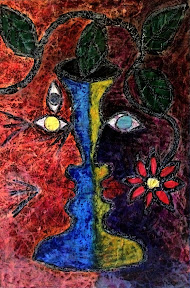
 At right is a version of Rubin's vase, after its inventor / discoverer the Danish psychologist Edgar Rubin. The Vase is classified as an 'optical illusion'; it's based on / emerges from 'flip-flopping' between figure and ground. We humans are supposed to be good at pattern-matching and pattern-making, which in turn implies we're good at integrating as well as differentiating --- making wholes out of parts as well as breaking wholes into parts. And in general doing all the stuff that's beloved of Gestalt psychologists.
A 'gestaltish' perspective is one in which both trees and forest are identified and evaluated appropriately, ie within their respective contexts. Gestaltish thinking minimises the risk of category error and agency (subject/object) confusion.
NIGHTMERRIES: THE LIGHTER SIDE OF DARKNESS This so-called "book" will chew you up, spit you out, and leave you twitching and frothing on the carpet. More than 60 dark and feculent fictions (read ‘em and weep) copiously illustrated by over 20 grotesque images you wouldn't want to meet in a dark alley.
AWAREWOLF & OTHER CRHYMES AGAINST HUMANITY (Vot could be Verse?) We all hate poetry, right? But we might make an exception for this sick and twisted stuff. This devil's banquet of adults-only offal features more than 50 satanic sonnets, vitriolic verses and odious odes.
MANIC MEMES & OTHER MINDSPACE INVADERS A disturbing repository of quotably quirky quotes, sayings, proverbs, maxims, ponderances, adages and aphorisms. This menagerie holds no fewer than 184 memes from eight meme-species perfectly adapted to their respective environments.
MASTRESS & OTHER TWISTED TAILS, ILLUSTRATED: an unholy corpus of oddities, strangelings, bizarritudes and peculiaritisms
FIENDS & FREAKS Adults-only Tales of Serpents, Dragons, Devils, Lobsters, Anguished Spirits, Gods, Anti-gods and Other Horse-thieves You Wouldn't Want to Meet in a Dark Kosmos: 4th Edition
HAGS TO HAGGIS Whiskey-soaked Tails of War-nags, Witches, Manticores and Escapegoats, Debottlenecking and Desilofication, Illustrated


I always enjoy optical illusions. So much fun! I've always wanted to take one of those Rorshach (I'm sure I misspelled it) ink blot tests, though I usually see pelvic bones, rats, or butterflies in the blots.
The word verification is "cling."
"Gestaltish thinking minimises the risk of category error and agency". I believe it is true. As a materialistic point of view, perceiving the true reality of certain things measured by material substance. Another standpoint is spiritual perception, which dwells on the subtlest aspects of life; spirit is truth, spirit is all and all other things are impermanent, illusions. Here duality of this or that automatically vanishes because anything material can't be remain all along the time, and how can we say spirit is material when we can't understand it within the realm of space, time and cause. so, when we say brain is holistic, parallel, and analog, with self-organizing tendencies that means it has to governed by something, which is itself holistic, parallel, and analog with self organizing capability. Then how can be all our thoughts and brains are different? Here there is long and profound philosophy of 'Karma' comes, but let me stop here..
Tempest, you got "rorschach" right, which probably says more about you than the results of any particular test would.
Shubhajit, I think "mind"/"soul"/"person" features holistic and self-organizing qualities, as you point out.
To which I would add: "dynamic" (ie always moving, never static); "emergent" (the qualities of the whole are greater than the sum of the parts, and emerge as a result of the gestalt of the parts); and process-oriented (ie mind/spirit/soul is not a thing but a process.
Your question "how can all our thoughts be different?" is a very tough question. Are all our thoughts different? Or do they just seem that way? Or are all of our thoughts running in the mind of the Creator at all times?
Thanks both for your comments.
MM
i am a pattern guy...love to look at things/people/numbers finding rhythms and patterns...it helps me make predictions and assess situations...
No wonder I always liked the gestalt way of looking at things. I love optical illusions like this, and enjoy the process of taking things apart and putting them back together in my mind.
Brian, humans are nothing if not pattern-makers, not to mention being expert pattern-breakers as well.
Audrey, yes, the mind seems to be somehow programmed to look for order, and when it finds none, to create some.
Thanks both for stopping by.
Very informative. Dr. Weirsdo often uses the phrase "category error," and now I understand better what he is talking about.
Hi weirsdo, yes it's a slippery concept, maybe unnecessarily so. Because thinking about it right now, at this moment, for the life of me I can't see how the folk wisdom in the phrase about comparing oranges with apples is any less informative or insightful than the term "category error".
And on that complex and convoluted note, thanks for your comment. Please call again at your earliest convenience!.
COMMENTS? Come on... gimme your best shot!